 How-to
How to Choose Niche Perfume Online: A 2026 Guide
Table of Contents
- Understanding Niche Perfume vs. Designer Fragrance
- Step 1: Research Fragrance Notes and Scent Profiles Before Ordering
- Step 2: How to Test Perfume Before Buying a Full Bottle
- Step 3: Ordering Niche Perfume Samples to Find Your Signature Scent
- Step 4: How to Identify Authentic Niche Perfume Brands
- Choosing Niche Fragrances for Different Occasions
- Making the Final Decision: Is This Niche Perfume Worth the Investment?
- Frequently Asked Questions
Last Updated: October 12, 2026
Understanding Niche Perfume vs. Designer Fragrance
Niche perfume is crafted by independent or artisanal perfumeries that prioritize artistic expression and unique scent profiles over mass-market appeal, typically using higher concentrations of quality ingredients in smaller production runs.
The difference is philosophy: designer fragrances aim for broad appeal, while niche fragrances prioritize distinctiveness and storytelling.
This matters when you choose niche perfume online because you're investing in something deliberately unconventional.
Step 1: Research Fragrance Notes and Scent Profiles Before Ordering
Before ordering samples, understand fragrance structure.
Reading descriptions teaches you what to expect: "citrus and bergamot" signals top notes that fade quickly, while "sandalwood and musk" signals lingering base notes.
Research the brand's philosophy too. Many niche brands publish their creative process, and a fragrance inspired by a specific place or emotion hits differently when you understand the artist's intention.
Create a reference list of scents you already like:
- Fragrances you wear now
- Scents you love in other forms (candles, lotions, natural sources)
- Smells that trigger positive memories
This preference map becomes your filter when browsing niche fragrance options online.
Step 2: How to Test Perfume Before Buying a Full Bottle
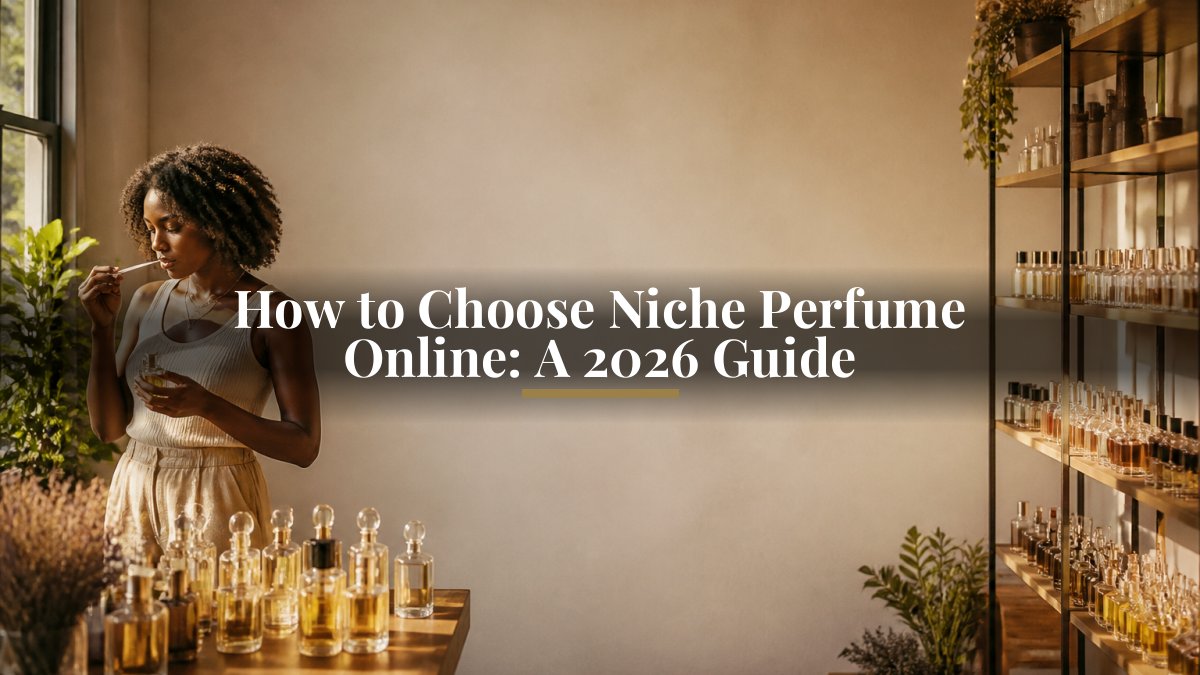
Testing perfume before committing to a full bottle is non-negotiable. Online shopping removes the ability to smell something in-store, and samples solve that problem.
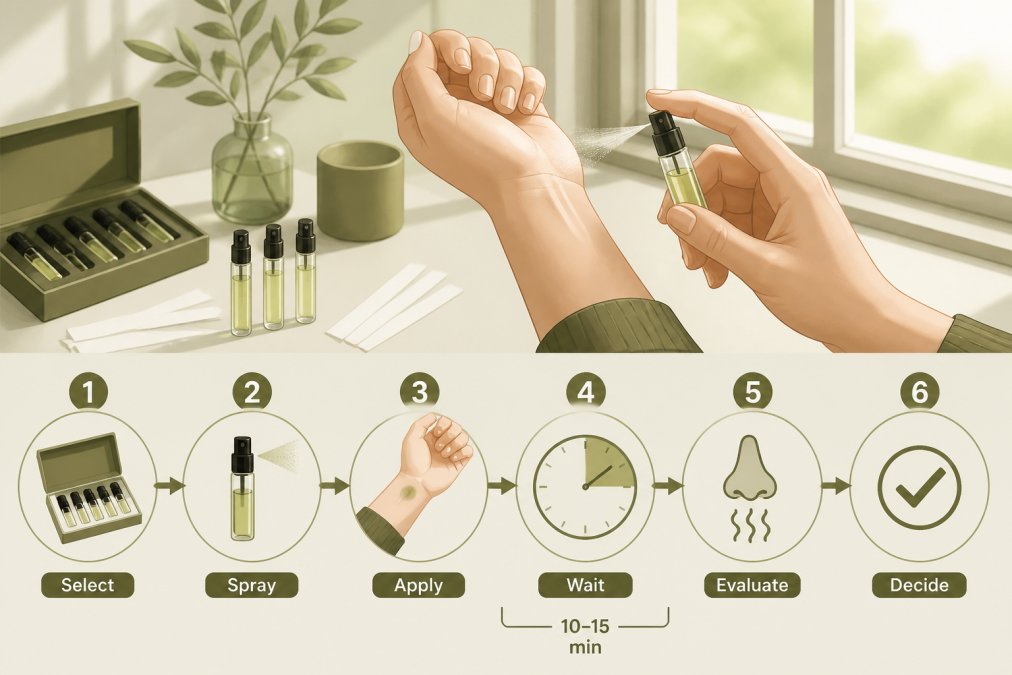
Order sample or discovery sets from niche retailers.
When you test, follow this process:
- Apply to clean skin, Test on your inner wrist or the inside of your elbow where skin is thinner and fragrance projects better
- Avoid layering scents, Don't wear other fragrances or strongly scented lotions on test day
- Wait 15 minutes, Let the top notes fade so you experience the heart and base
- Smell throughout the day, Note how the fragrance evolves over 4-6 hours
- Check projection and sillage, Observe whether others can smell it or if it stays close to your skin
- Evaluate on your skin specifically, Skin chemistry varies. A fragrance that smells beautiful on a friend might smell different on you (ncbi.nlm.nih.gov)
Many people decide based on the first smell, but top notes are designed to be attractive initially.
Sensory overload happens when you test too many fragrances at once.
Step 3: Ordering Niche Perfume Samples to Find Your Signature Scent
Ordering niche perfume samples online is straightforward once you know what to look for.
Check the retailer's sample size and format. Spray samples (often 2ml vials) are generally better than dab bottles because they deliver consistent doses and let you test projection.
Look for retailers that offer:
- Sample sets organized by scent family or brand
- Individual sample ordering if you want to cherry-pick fragrances
- Clear return or exchange policies
Keep organized notes as you test. Track in a spreadsheet:
- Fragrance name and brand
- Top, heart, and base notes
- First and lasting impressions
This prevents decision fatigue, after 10 fragrances, you'll forget which one you loved unless you wrote it down.
A signature scent is one you reach for repeatedly because it aligns with your preference and skin chemistry.
Step 4: How to Identify Authentic Niche Perfume Brands
Counterfeit fragrances exist in the niche market, and online buying removes the in-store cues you'd normally rely on. The goal isn't forensic authentication, it's a short verification routine that filters out most bad actors before you spend money.
Verify the seller before you verify the bottle
Start with the seller, not the product page. A legitimate operation is easy to confirm in about five minutes:
- Find a physical address and a working phone number. A street address and an answerable phone line are baseline signals; a contact form alone is not.
- Check the domain age and the About page. A brand-new domain selling deeply discounted niche bottles is a common counterfeit pattern. Look for a real About page with a named founder or team, not stock copy.
- Confirm the seller is an authorized retailer or the brand itself. Cross-check against the brand's own list of authorized stockists. Buying direct from the brand or a listed authorized retailer is the single most reliable way to avoid counterfeits.
- Read the return policy in full before ordering. Look for the return window (commonly 14-30 days), whether opened bottles are eligible, who pays return shipping, and whether returns are refund or store credit only. A seller that won't accept returns on opened fragrance is telling you something.
- Search the seller's name plus "counterfeit" or "fake." Community forums and review sites surface patterns faster than any product page.
Red flags that should stop the purchase
- Prices significantly below the brand's own retail price, especially on current releases. Niche houses rarely discount current stock deeply, and never across the whole catalog at once.
- Vague or missing return policies, or policies that exclude fragrance entirely.
- No batch code, no production date, or a refusal to provide either when asked.
What to check when the bottle arrives
- Batch code. Most fragrance houses print a batch code on the box and on the bottle; they should match. Look the code up against the brand's dating system or a public batch-code database.
- Atomizer and cap fit. Counterfeits frequently have loose caps, misaligned sprayers, or a spray that dribbles rather than mists.
- Fluid color and clarity. Compare against the brand's official product photos. Unexpected cloudiness or an off color is a reason to pause.
A note on buying direct
Buying directly from the brand's website removes most of this risk, since you're dealing with the maker rather than a reseller. You also get the brand's own return policy, batch codes, and customer service. For a first purchase from an unfamiliar house, direct is usually the lower-risk path even if the sticker price is higher.
Quick seller checklist
| Check | What good looks like |
|---|---|
| Address and phone | Real street address, answerable phone |
| Authorization | Listed as a stockist by the brand, or is the brand |
| Return policy | 14-30 days, opened bottles eligible, refund not just credit |
| Pricing | Within normal range of the brand's retail price |
| Batch codes | Provided on request, match on box and bottle |
| Reviews | Independent reviews mention authenticity and shipping, not just scent |
Run this checklist once per new seller. After that, you can reorder with confidence and spend your energy on the fragrance itself.
Choosing Niche Fragrances for Different Occasions
Daytime fragrances tend to be lighter and fresher.
Evening fragrances can be richer and more intense.
Professional settings call for restraint.
Casual occasions give you freedom to explore distinctive or unconventional scent profiles. This is where truly unique niche fragrances shine.
Your personal preference matters more than any rule, if you love a heavy fragrance and want to wear it daily, that's your choice.
Making the Final Decision: Is This Niche Perfume Worth the Investment?
After testing samples, you'll usually have two or three finalists and one question: which earns a full bottle? A structured scorecard turns that gut call into a decision you can defend six months later.
Scents of Atlanta Collection →
Start with the math: price per milliliter
Niche bottles are expensive, and the sticker price alone does not tell you which is the better value. Convert every finalist to a price-per-milliliter figure before you compare:
Price per milliliter = bottle price ÷ bottle size in milliliters
A 50 ml bottle at $150 works out to $3.00 per ml; a 100 ml bottle at $220 works out to $2.20 per ml. The larger bottle is the better value per ml, but only if you'll actually finish it.
A rough way to think about it: a typical spray delivers about 0.1 ml, so a 50 ml bottle is roughly 500 sprays.
The five-factor scorecard
Score each finalist from 1 to 5 on the factors below, then total and compare. The point isn't the number itself, it's forcing yourself to weigh performance and price alongside the emotional pull.
| Factor | What to score | 1 (weak) | 5 (strong) |
|---|---|---|---|
| Preference | How much you actually enjoy wearing it | You tolerate it | You reach for it unprompted |
| Versatility | How many settings it fits | One narrow occasion | Works across most of your week |
| Performance | Wear time and projection on your skin | Fades under 2 hours | Lasts 6+ hours with controlled projection |
| Price and value | Price per ml against your budget | Over budget with no clear justification | Fits budget and earns its per-ml cost |
| Sample experience | How the full-day test went | You wanted to wash it off | You were sorry when it faded |
A finalist that scores 4 or 5 on preference and performance but 2 on price is a "save for later," not a "buy now." One that scores 5 on price and versatility but 3 on preference is a compromise you'll resent.
The four-question gut check
Before you click buy, answer these plainly:
- Does it beat what I already own? If a fragrance you have does the same job better, you're buying a duplicate, not an addition.
- Will I wear it at least once a week? If the honest answer is "a few times a year," a decant or another sample is the better spend.
- Does the price feel justified for the quality and wear time I measured? Not for the brand story, for the performance you observed on your skin.
- Can I afford it without strain? Fragrance is discretionary. If the answer is no, wait, the fragrance will still be there, and so will the samples.
If you answer yes to all four, buy the bottle. If you hesitate on any one, order another round of samples and keep testing. Hesitation is data.
When to buy a decant instead of a full bottle
A decant, a smaller portion transferred from a full bottle into a travel atomizer, sits between a sample and a full bottle. It's useful when a fragrance scores high on preference but low on versatility, or when you love it but can't justify the full-bottle price yet. Many niche sellers and community members offer decants in 5 ml and 10 ml sizes, enough for dozens of wears to confirm the love before committing.
A realistic timeline
Most people who buy well don't decide in a single afternoon. A common pattern:
- Week 1: Order samples or a discovery set.
- Weeks 2-3: Wear each sample on a full day, take notes, and score them.
- Week 4: Re-test the top two finalists on separate days.
There's no prize for deciding fast. The cost of a wrong full bottle is far higher than one more sample order.
Frequently Asked Questions
How do I know if a niche perfume will work on my skin chemistry before buying online?
Test a sample on clean skin over a full day, at least 8 hours. Skin chemistry varies; what smells beautiful on paper may differ on your skin. Order niche perfume samples first rather than committing to a full bottle. Wear the sample during your normal routine to observe how the scent evolves, how long it lasts, and whether it feels right for you. Pay attention to sillage (how far the scent projects) and longevity, as these vary based on your skin's pH and natural oils.
What should I look for when interpreting fragrance notes in online descriptions?
Fragrance notes are organized in a pyramid: top notes (initial scent, fade in 5-15 minutes), heart notes (the main character, lasting 2-4 hours), and base notes (foundation, lasting 6+ hours). Read the full note structure, not just the headline. If you dislike one note, check whether it appears in the top (temporary) or base (lasting) section. Look for reviews mentioning how the scent evolves over time. Niche perfume descriptions often explain the creative process and brand philosophy, which can signal authenticity and help you decide if the artistic vision matches your personal preference.
How can I verify a niche perfume brand is authentic before ordering?
Check the brand's official website for transparency about production, ingredients, and brand history. Authentic niche perfume makers typically share their creative process and sourcing philosophy. Verify the retailer is authorized, check the brand's site for an approved seller list. Look for consistent packaging, batch codes, and proper labeling. Read customer reviews mentioning wear time and sillage consistency. Be cautious of prices significantly lower than the brand's official site, as this often signals counterfeit fragrance. Request return policies and sample options before committing to a full bottle purchase.
How long should I test a niche perfume sample before deciding to buy a full bottle?
Test for at least 3-5 days of regular wear to understand how it performs on your skin. One-time testing may not reveal how the scent evolves with your body chemistry or whether it suits your lifestyle. Wear it in different environments, work, evening, casual outings, to assess occasion suitability. Notice whether you reach for it naturally or feel indifferent. If you're still drawn to it after a week of testing, and the wear time and projection meet your expectations, it's likely worth the investment in a full bottle.