 ultimate-guide
How to Tell Quality Perfume: A 2026 Guide to Real Scents
Table of Contents
- What Quality Perfume Actually Means (And What It Doesn't)
- Inspect the Packaging and Bottle Before You Judge the Scent
- Perfume Concentration Guide: How Strength Shapes Performance
- Niche vs Designer Perfume Differences: Why Composition Matters
- How to Test Perfume Longevity on Skin, Not Just Paper
- Conclusion: Build Your Own Quality Scorecard
- Frequently Asked Questions
Last Updated: October 6, 2026
What Quality Perfume Actually Means (And What It Doesn't)
Quality perfume is a fragrance built from a deliberate composition of ingredients, blended at a stated concentration, that develops predictably on skin and holds its character for hours rather than minutes.
The opening notes of any perfume, good or bad, are the loudest and least representative part of the formula. Judging quality there is like judging a restaurant by its bread basket.
Below, we break down the three pillars that separate a well-made fragrance from a cheap one, then give you a repeatable testing method.
The Three Pillars of Perfume Quality
Composition is how the ingredients are put together. A quality composition uses a structured arc: opening notes, a heart that carries the character, and a base that anchors everything for hours.
Concentration is the ratio of fragrance oil to alcohol or carrier. More oil generally means longer wear, though not always a better scent.
Development is how the fragrance changes on your skin over time. This is where quality shows most clearly. A good perfume evolves; a bad one just fades.
Inspect the Packaging and Bottle Before You Judge the Scent
Physical inspection is the fastest filter you have. Counterfeit and low-grade fragrances almost always cut corners somewhere visible.
Start with the box. Genuine packaging uses crisp printing, consistent typography, and tight seams; blurry text, mismatched fonts, or flimsy cardboard are warning signs.
Then examine the bottle. Quality glass has even thickness and no bubbles or seams. The cap should seat firmly and feel substantial. The atomizer should produce a fine, even mist, not a sputtering stream.
Perfume Concentration Guide: How Strength Shapes Performance
Concentration is the most misunderstood factor in fragrance buying. The label tells you roughly how much fragrance oil is in the bottle, and that number predicts wear time far better than price does. But concentration alone does not prove quality.
Here is how the main categories compare:
Concentration | Typical Oil Level | Expected Wear | Best For |
|---|---|---|---|
Eau de cologne | Lowest | 2-4 hours | Fresh daytime refresh |
Eau de toilette | Light | 4-6 hours | Daily office wear |
Eau de parfum | Moderate to high | 6-8 hours | Evening and cool weather |
Parfum / extrait | Highest | 8+ hours | Statement wear, special occasions |
Those ranges are starting points, not guarantees. A high concentration of poor ingredients still smells poor, and skin type affects wear as much as the formula does.
Scents of Atlanta Collection →
Why Concentration and Longevity Are Not the Same Thing
More oil does not automatically mean better performance. Three variables drive longevity on skin:
- Oil concentration sets the ceiling on how much fragrance material is available to evaporate.
- Ingredient volatility determines how quickly those materials leave the skin. Some high-impact base materials cling for hours even at low percentages; some bright top-note materials disappear in minutes regardless of concentration.
- Skin and environment, moisture, body heat, humidity, and airflow, change evaporation speed from person to person and day to day.
That is why a well-made eau de toilette can outperform a poorly made eau de parfum, and why a parfum worn in dry winter air may read softer than the same bottle in summer humidity.
How to Test Performance Realistically
Rather than trusting the label, run a two-day test:
- Day one, one spray on one wrist. Note the time. Check at 30 minutes, 2 hours, 4 hours, and 6 hours.
- Record what you smell at each check, is the character still recognizable, or has it flattened into a generic base?
- Day two, repeat on the other wrist at the same time of day. Skin behaves differently depending on temperature and activity.
- Compare the two days. If the fragrance performs consistently across both, the formula is stable on you. If it collapses on one day and holds on the other, the issue is likely environmental rather than the juice itself.
A fragrance that still reads clearly at four hours is performing at or above its stated concentration class; one unrecognizable by hour two is underperforming its label.
This is why our approach at Atlanta Signature Fragrance Collection leans on structured, layered compositions rather than raw strength.
Niche vs Designer Perfume Differences: Why Composition Matters
The niche versus designer distinction is about who the fragrance is made for, not whether it is good. Designer houses develop scents for the widest possible audience, pushing formulas toward safe, familiar profiles.
That difference shows up in composition. Niche fragrances often use a more unusual opening, a more complex heart, and a base with a distinct point of view.
Neither approach is automatically higher quality. A designer fragrance can be beautifully made. A niche fragrance can be badly made and expensive.
What Composition Quality Actually Looks Like
Instead of asking whether a fragrance is niche or designer, ask whether its composition holds together. Four things to evaluate:
- Balance. Do the notes support each other, or does one ingredient shout over the rest? A well-blended fragrance reads as a single impression rather than a list of separate smells.
- Development arc. Does the scent move through distinct stages, opening, heart, base, in a way that feels intentional? Or does it smell the same from first spray to last hour, or collapse abruptly?
- Blending. Can you pick out individual ingredients, or do they merge into something new? Both can be valid, but harsh, disjointed transitions usually signal a rushed formula.
- Base quality. The base is where cheap formulas fail most often. A thin, sharp, or metallic drydown after an appealing opening is a common pattern in low-grade compositions.
A Repeatable Quality Scorecard
Use the same criteria every time you evaluate a fragrance so comparisons are fair. Score each category pass or fail:
Criterion | What to Check | Pass Looks Like |
|---|---|---|
Balance | Do notes support each other? | Reads as one cohesive scent |
Development | Does it evolve on skin? | Distinct, intentional stages |
Blending | Are transitions smooth? | No harsh or disjointed jumps |
Base | How does the drydown hold up? | Rich, stable, not thin or sharp |
Performance | Does it last per its concentration? | Still recognizable at 4+ hours |
Value | Does quality justify the price? | Matches or exceeds expectations |
A fragrance that passes most of these is well made, whether it costs a little or a lot. One that only smells good in the first minute fails on development and base.
For anyone who wants a fragrance that does not smell like everyone else in the room, the niche and artisanal side of the market is where the interesting work happens. That is the space we work in, and it is why handcrafted, small-batch production matters.
How to Test Perfume Longevity on Skin, Not Just Paper
Paper strips are a starting point, never a verdict. A blotter tells you what the fragrance smells like in the abstract; your skin tells you what it smells like on you, frequently different scents.
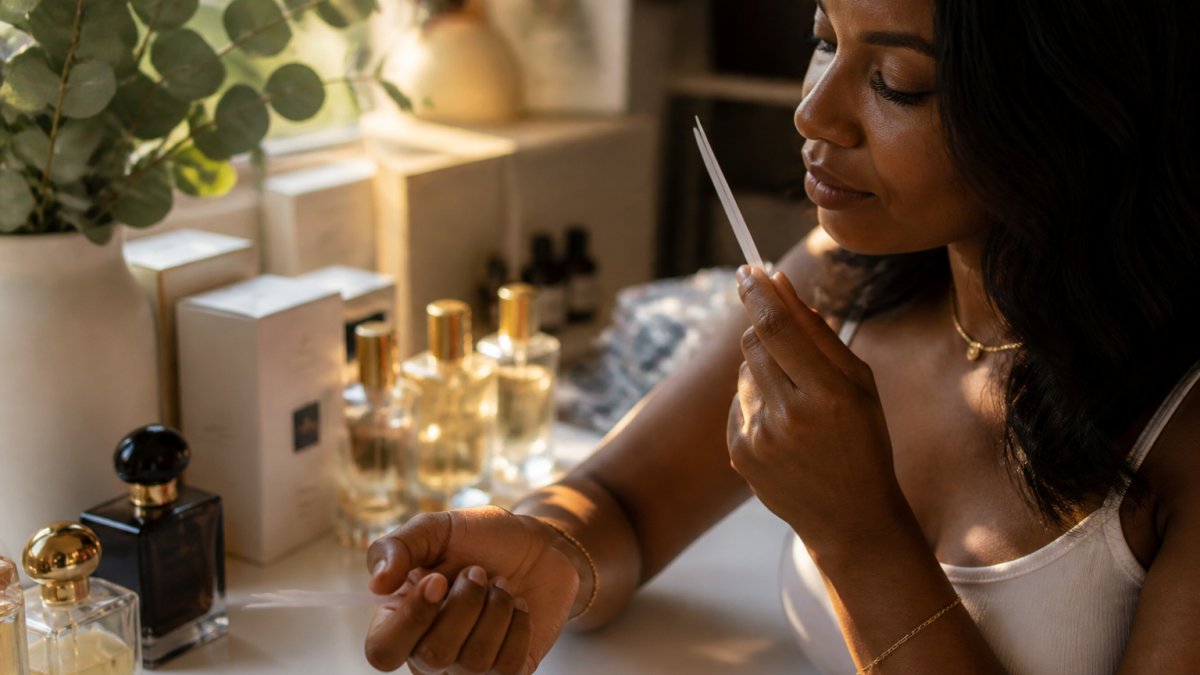
Skin chemistry, body heat, and moisture all interact with a formula, which is why a fragrance that smelled incredible on a blotter can turn sharp or flat within twenty minutes.
Scents of Atlanta Collection →
A Step-by-Step Skin Testing Method
Follow this sequence for any fragrance you are seriously considering.
- Apply to clean, unscented skin. Moisturizer, soap residue, and other fragrances will distort the result.
- Spray one fragrance per wrist or inner forearm. Never test two scents on the same patch.
- Smell immediately, then wait. Note the opening, but do not judge yet.
- Check at 30 minutes. This is the heart of the fragrance and the most honest read on its character.
- Check at 2 hours. Note whether the scent has deepened or thinned out.
- Check at 4 to 6 hours. This tells you the base and the real longevity.
- Write down each stage. Memory for scent is unreliable; notes are not.
Test no more than two or three fragrances per session. Your nose fatigues quickly, and after the fourth or fifth scent everything blurs.
Conclusion: Build Your Own Quality Scorecard
Score every fragrance you test on four things: composition, concentration, development, and authenticity. Give each a pass or fail, and let the pattern decide rather than the first impression.
A fragrance that scores well on all four is worth its price. One that only smells good in the first minute is not.
That standard is exactly what we build to at Atlanta Signature Fragrance Collection. Every scent is handcrafted in small batches, unisex by design, and composed to develop on skin rather than shout from the bottle.
Frequently Asked Questions
How can you tell if a perfume is high quality?
High-quality perfume shows a clear progression from opening notes to dry-down. On skin, it should last several hours without turning sharp or synthetic. Check the bottle weight, cap fit, and atomizer spray pattern. A fragrance that smells the same from first spray to final hour is often a sign of cheap construction.
Does longevity of a scent indicate its quality?
Longevity is one signal, not the whole story. A perfume can last 10 hours because it is loaded with heavy synthetics that smell flat, while a well-composed extrait may last 6 hours with beautiful development. Concentration affects staying power: eau de toilette typically lasts 2-4 hours, eau de parfum 4-6, and parfum 6-8 or more. Judge quality by how the scent evolves, not just how long it lingers.
Is a 7-year-old perfume still good?
It can be, if stored properly. Heat, light, and air are the enemies. A bottle kept in a cool, dark place with the cap tight may still smell close to original after 7 years. Signs it has turned: darker liquid, a vinegar or alcohol sharpness, or loss of top notes. If it smells off, do not use it on skin.
What are the signs of a well-composed niche fragrance?
A well-composed niche fragrance has distinct opening, heart, and base phases that transition smoothly. It uses quality ingredients that do not smell harsh or chemical. The projection is noticeable but not overwhelming, and sillage leaves a subtle trail. Packaging is solid, with a weighty bottle and precise atomizer. It should feel intentional, not like a single accord stretched thin.