 blog
Best Perfume for Sensitive Skin: A Practical Guide
Table of Contents
- Understanding Fragrance Sensitivity vs. Allergic Reactions
- What Makes a Perfume Hypoallergenic
- How to Test Perfume for Sensitive Skin
- Skin Scents and Low-Sillage Options
- Perfume for a Sensitive Nose
- Key Ingredients to Avoid and Why They Matter
- Best Practices for Wearing Fragrance Safely
- Frequently Asked Questions
Last Updated: October 7, 2026
Understanding Fragrance Sensitivity vs. Allergic Reactions
Fragrance sensitivity and allergic reactions differ, and the distinction changes how you find a perfume for sensitive skin.
Fragrance sensitivity is irritation, not an immune response. Your skin reacts to fragrance molecules with redness, burning, dryness, or tightness when the concentration or chemical profile overwhelms your tolerance threshold.
Allergic contact dermatitis is an immune response: your body treats a specific ingredient as a threat, producing a localized rash, sometimes with blistering or severe itching that persists for days. The same ingredient triggers it every time.
Scent-triggered symptoms are separate from skin reactions. Some people get headaches, nausea, or respiratory irritation from airborne fragrance, tolerating a scent on their skin but not its sillage.
At Atlanta Signature Fragrance Collection, we recognize these distinctions.
What Makes a Perfume Hypoallergenic
"Hypoallergenic" gets used loosely in fragrance marketing, so it's worth understanding what it actually means and how to evaluate claims.
A hypoallergenic perfume is formulated to minimize common allergens and irritants, typically meaning:
- Lower alcohol content (which can dry and irritate skin)
- Fewer synthetic fragrance compounds known to trigger reactions
- Exclusion of common allergens like oakmoss, certain musks, or specific essential oils
- Higher quality ingredients with cleaner sourcing
But "hypoallergenic" is not a regulated claim in the United States. The FDA does not define the term, require testing, or certify the label, and cosmetics need no pre-market approval.
Large fragrance houses use the term too, with no more legal weight. What actually reduces reactions is allergen-free formulation or ingredient transparency: a brand that lists every component and flags known allergens lets you decide.
The difference between "hypoallergenic" and "allergen-free":
| Claim | What it means | Regulatory weight |
|---|---|---|
| Hypoallergenic | Formulated to reduce allergens; no standard definition | None; marketing term |
| Allergen-free | Contains no known allergens from a specified list | Depends on the list and testing method |
| Fragrance-free | No added fragrance; may still contain masking scents | FDA has no formal definition |
| Dermatologist-tested | Tested on human subjects under dermatological supervision | No standard protocol required |
Brands making the strongest "hypoallergenic" claims are often the least transparent. Under U.S. labeling rules, "fragrance" is a protected trade secret, so companies can legally hide dozens of compounds behind it.
When shopping for a perfume for sensitive skin, skip the "hypoallergenic" label and look for ingredient transparency and allergen disclosure. If a brand won't tell you what's inside, the claim doesn't matter.
FDA guidance on cosmetic labeling and fragrance ingredient disclosure
How to Test Perfume for Sensitive Skin
Testing is non-negotiable. A proper patch test takes three days and tells you whether your skin will tolerate the fragrance.
The patch test protocol:
- Apply a small amount (about the size of a pinhead) to clean, unscented skin on your inner forearm or behind your ear
- Cover the area with a bandage or leave it exposed, both methods work
- Wait 24 hours without washing the area
- Check for redness, burning, itching, rash, or dryness
- Remove the bandage and observe for another 48 hours
If your skin remains clear through all three days, the fragrance is likely safe for you. If you see any reaction within that window, stop immediately and wash the area.
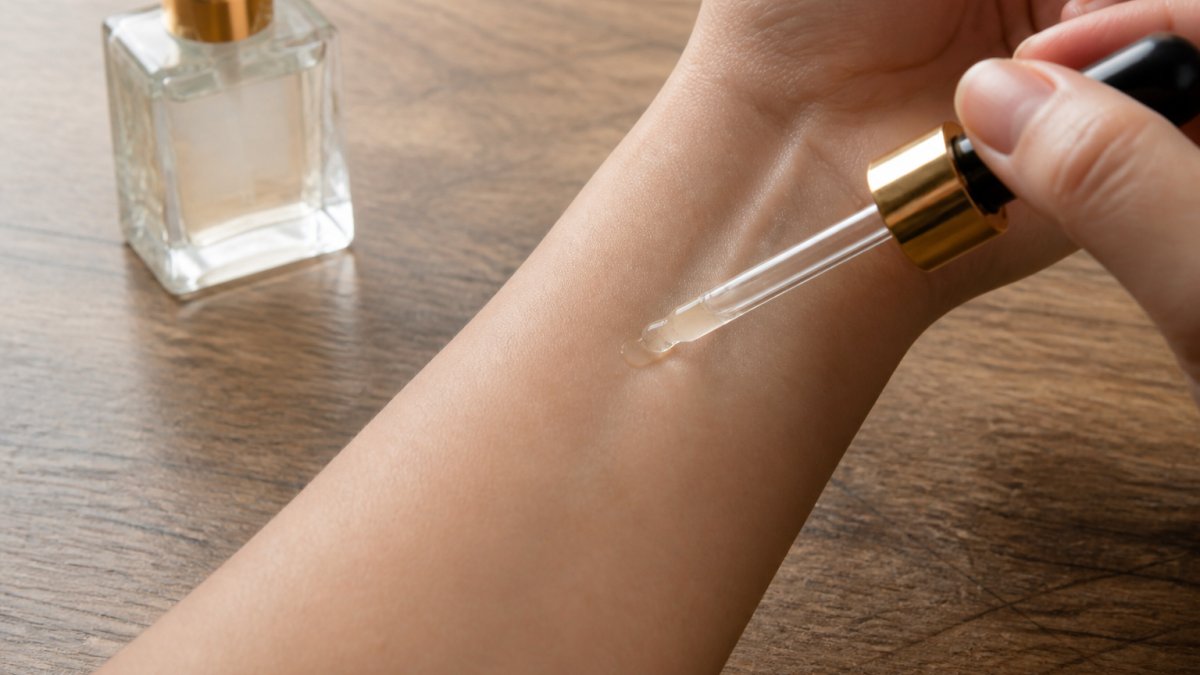
Why three days? Allergic contact dermatitis can take 24-72 hours to develop, so a one-day test can miss a reaction that appears on day two.
Test only one new fragrance at a time, introduce three at once and you won't know which caused a reaction.
Your forearm is ideal, visible and accessible. Behind the ear works but is harder to monitor.
Skin Scents and Low-Sillage Options
If you have sensitive skin, you may tolerate a fragrance better when it stays close to your body, which is where skin scents and low-sillage perfumes help.
Skin scents project minimally, blooming on your skin rather than across a room. For sensitive skin the benefit is twofold: lower concentration means less irritation potential, and minimal sillage means you're not inhaling strong molecules all day.
Scents of Atlanta Collection →
Low-sillage fragrances sit between skin scents and traditional perfumes, projecting a few feet rather than a room, ideal if you worry about triggering headaches or respiratory irritation in others.
For sensitive noses, low-sillage is often preferable regardless of skin tolerance: a fragrance that causes no skin irritation but throws intense airborne molecules can still trigger nausea or headaches.
Formulation matters: eau de toilette (3-5% concentrate) projects less than eau de parfum (15-20%). If you're sensitive, start with eau de toilette or a dedicated skin scent.
Perfume for a Sensitive Nose
A sensitive nose differs from sensitive skin, though the two can coexist. Some people get headaches, nausea, or respiratory irritation from strong fragrances; others simply find intense scents overwhelming.
For a sensitive nose, intensity and projection matter more than ingredients: perfect ingredients with powerful sillage will still trigger symptoms, while some common irritants at minimal projection may feel fine.
Practical strategies for a sensitive nose:
- Choose low-sillage or skin-scent fragrances that stay close to your body
- Apply to areas you don't bring near your face (lower arm, behind the ear, chest)
- Use a light hand, one or two spritzes instead of five
- Avoid reapplying throughout the day; let the fragrance naturally fade
- Test in short bursts before committing to full wear
Certain scent profiles trigger reactions more than others: fruity or floral fragrances with high aldehydes can feel sharp and headache-inducing, while woody or soft fragrances with gentle base notes often feel more comfortable. This is individual.
When shopping for a perfume for a sensitive nose, ask about intensity first. Brands with detailed scent profiles and sillage descriptions help you predict whether a fragrance will work.
Key Ingredients to Avoid and Why They Matter
Certain fragrance ingredients show up repeatedly in sensitivity reactions. Knowing what they are and how to spot them on a label helps you choose wisely.
Common fragrance allergens and irritants:
-
Oakmoss (Evernia prunastri): A natural lichen extract once common in chypre and fougère fragrances. Its atranol and chloroatranol are among the most common causes of allergic contact dermatitis from fragrance. The IFRA has restricted its use, and many modern formulas replace it. Treat "oakmoss" or "Evernia prunastri" on a label as higher-risk.
-
Synthetic musks (galaxolide, tonalide, musk ketone): Fixatives that extend longevity. Polycyclic musks like galaxolide and tonalide can accumulate in skin tissue and trigger delayed allergic reactions, and they persist in the environment. Nitro musks, an older class, are more strongly linked to allergic contact dermatitis and have been largely phased out.
-
Certain essential oils: Ylang-ylang, jasmine absolute, rose absolute, and sandalwood contain natural compounds that irritate some skin types. Natural isn't inherently safer, essential oils hold hundreds of compounds, some potent allergens. Linalool and limonene, common in floral and citrus oils, oxidize in air and become more sensitizing over time.
-
High aldehyde concentrations: Synthetic aldehydes (as in classic Chanel No. 5-style fragrances) create sharp, piercing profiles. They're more likely to irritate a sensitive nose and trigger headaches than to cause skin reactions, but can do both.
-
Parabens (methylparaben, propylparaben, butylparaben): Preservatives that prevent microbial growth. Some people react to them. They're a separate concern from fragrance allergens but appear in many perfumes and can compound irritation for reactive skin.
How to read a fragrance label for sensitive skin:
-
Look for "fragrance" or "parfum." Under U.S. law this single term can legally hide dozens of compounds, telling you nothing about what's inside.
-
Check for allergen disclosure. Some brands voluntarily list known allergens with INCI names like "Linalool," "Limonene," "Citronellol," or "Eugenol", common allergens the EU requires labeled above certain concentrations. U.S. brands aren't required to, but many do.
-
Look for exclusion claims. "Free of oakmoss, synthetic musks, and parabens" is concrete information; "hypoallergenic" alone is not.
-
Check for IFRA compliance. The International Fragrance Association sets ingredient safety standards, giving at least some third-party framework, though compliance doesn't guarantee your specific skin won't react.
-
Ask for a full allergen list. Transparent brands provide one. If they won't, that's your answer.
Why "natural" doesn't mean safe:
Scents of Atlanta Collection →
A common misconception is that natural or essential oil-based fragrances are gentler than synthetic ones. Not reliably: essential oils are chemically complex and many contain known allergens.
The trade secret problem:
Fragrance ingredients are often listed generically as "fragrance" or "parfum" under trade secret protection, so even a product labeled "hypoallergenic" can contain undisclosed allergens. Transparent brands break this down voluntarily or at least identify which known allergens are excluded.
Quality matters: lower-standard synthetics contain impurities that increase irritation potential, and artisanal fragrances using higher-grade synthetics and carefully sourced oils tend to be gentler, though price alone doesn't guarantee quality.
When evaluating a perfume for sensitive skin, look for brands that disclose allergen exclusions and full ingredient lists. "Free of oakmoss, synthetic musks, and parabens" is concrete; "hypoallergenic" alone is not.
IFRA standards for fragrance ingredient safety
Best Practices for Wearing Fragrance Safely
Application technique:
Apply to pulse points, behind the ears, inner wrists, inside elbows, where warmer skin diffuses fragrance evenly.
For sensitive skin, apply to clothing instead: a light spray on fabric delivers scent without skin contact.
Frequency and timing:
One application per day usually suffices, especially with eau de parfum. Reapplying intensifies exposure and irritation risk; if you must, use a lighter hand.
Apply in the morning after skincare has fully absorbed, layering over damp skin intensifies irritation. Give skin 10-15 minutes to dry after cleansing.
Environmental factors:
Heat and humidity increase intensity and projection, so use less in warm weather than in winter.
Store fragrance cool and dark, heat and light break down molecules into irritating byproducts. A bedroom shelf beats a bathroom cabinet near a shower.
| Best Practice | Application | Frequency | Timing |
|---|---|---|---|
| Pulse point application | Behind ears, inner wrists, inside elbows | Once daily | After skincare fully absorbs |
| Clothing application | Light spray on fabric, not skin | Once daily | Morning or evening |
| Sensitive skin | Minimal amount, 1-2 spritzes max | Once daily | 10-15 minutes after cleansing |
| Sensitive nose | Low-sillage fragrance only | Once daily | Away from face and breathing zone |
Finding the right perfume for sensitive skin takes patience and testing, but it's possible.
At Atlanta Signature Fragrance Collection, we craft artisanal fragrances.
Frequently Asked Questions
What's the difference between fragrance sensitivity and a true fragrance allergy?
Fragrance sensitivity typically causes mild reactions like headaches, nausea, or respiratory irritation when exposed to scent. A true allergic reaction involves skin symptoms such as rash, burning, or dryness that occur after direct contact with fragrance ingredients. Allergic contact dermatitis is an immune response to specific allergens in the fragrance, while sensitivity is often a reaction to fragrance intensity or volatile compounds. If you experience severe skin reactions or difficulty breathing, seek medical advice to determine whether you have a true allergy or sensitivity.
Are hypoallergenic perfumes actually allergen-free?
No fragrance is completely allergen-free, but hypoallergenic perfumes are formulated to minimize common irritants and allergens. 'Hypoallergenic' means the product is less likely to cause allergic reactions, not that it contains zero allergens. These fragrances typically avoid synthetic musks, heavy alcohol content, and known irritants. Always review ingredient lists and perform a patch test before full wear, even with products labeled hypoallergenic. Individual reactions vary widely based on skin chemistry and personal sensitivities.
How do I perform a reliable patch test for perfume on sensitive skin?
Apply a small amount of fragrance to your inner wrist or behind your ear, areas with thinner skin that better mimics facial sensitivity. Wait 24 to 48 hours and observe for redness, itching, burning, or rash. Keep the test area unwashed during this period. If no skin reaction occurs, apply a small amount to your neck or chest to test for scent-triggered symptoms like headaches or nausea over several hours.
What fragrance application methods work best for sensitive skin?
Avoid direct skin contact by applying fragrance to clothing, hair, or fabric surfaces instead. Spray fragrance into the air and walk through the mist, allowing it to settle on your body without concentrated contact. Use a single spray rather than multiple applications. If applying to skin, choose areas with less sensitive skin like the inside of your wrists or behind your ears rather than the neck or chest. Start with minimal amounts and gradually increase if tolerated. These methods reduce direct skin exposure while still allowing you to enjoy the scent profile.